Some time ago, I decided that rather than separating the mouthpiece entirely from the horn, it would likely be more musically useful to infuse electronic sound directly into the horn. My vision was that one would play the trumpet as normal, but get a synth-like sound out of the bell. The entire resonant characteristic of the horn would be altered, effectively allow one to directly “play” a square wave. What would that feel like on the lips?
As I began theorizing approaches to making this theoretical Stella v2 a reality, I realized I didn’t really have any bearings on what direction to take. Given that any particular direction would likely require significant financial and time investment, with no guarantee of payoff, I set out to look into prior research that has been done on this topic. As it turns out, there is a lot.
I knew I wanted some way to integrate electronic sound directly into the horn, but there are so many ways to approach this problem – you can infuse electronic tones into the mouthpiece bore, place a loudspeaker at the bell, or maybe even have a fixed length of tubing with a mic/speaker combo at the end that simulates any acoustic transfer function. To my surprise, it turns out that individuals at universities around the world have had the same ideas, and have dedicated months to years of their lives attempting to make them work. Fortunately, they documented their efforts.
Pickett at the Bore
The first paper I found that really blew my socks off was a Master’s thesis out of Virginia Tech by a fellow named Peter Pickett [1]. Back in 1998, he tried the direct approach – pipe the output of a hefty speaker directly into the mouthpiece bore through a small hole, using a collocated mic passing through a feedback algorithm to determine the phase and frequency to pass back in. Here’s what his mouthpiece and test setup looked like:
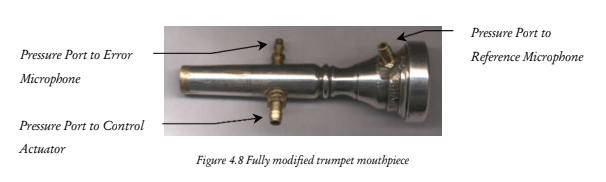
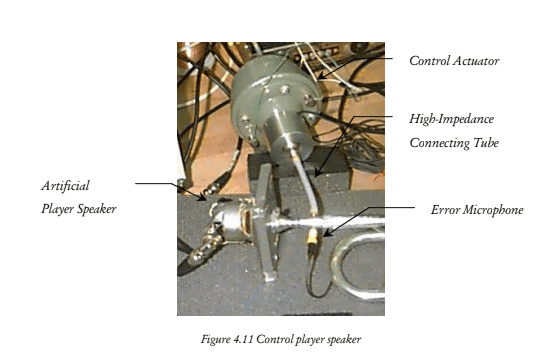
There are no sound demos, though the results seem to indicate some control over the attenuation of specific frequency bands is possible. However, the massive issue that emerged is that it is nigh impossible to find a viable driver that can generate a high enough pressure level to compete with the existing pressure levels in the horn. In fact, Pickett dedicates an entire section of the paper to proving that such a speaker, with the traditional magnetic coil design, cannot be constructed.
While it could be fruitful to keep pushing on this approach, I do find that this paper discourages me from trying bore injection. The logistics seem like a nightmare, and I have serious doubts that a fully functional solution would be ergonomically viable.
On a more inspirational note, after graduating with his master’s, Pickett went on to work in the printing industry and made significant technological advances in that field. On the side, he started manufacturing trumpet mouthpieces. 15 years later, he went full time and now works full time making trumpets as owner of Pickett Blackburn.
Meurisse at the Bell
Another exciting approach has been taken by Thibeut Meurisse in 2015 as part of a larger program called IMAREV, which seeks to explore the possibilities of “Active” instruments. Meurisse approaches the problem from the end of the horn, instead collocating speaker and mic at the end of the tube [2]. Here’s what their experimental setup ended up looking like:

Again, no audio examples are present, and the results do not point to the tremendous level of control one might hope for. However, some control over specific resonances is achieved.
Meurisse also leans heavily into the idea of “Active Modal Control”, where one focuses on tempering specific resonant modes of the instrument rather than targeting frequency ranges. I will not pretend to understand the math behind this, but this approach feels more intuitive to me.
Buys goes Hybrid
It is important to differentiate here between two approaches to this whole problem – active instruments vs hybrid instruments. While active instruments seek to integrate electronic sound alongside the performer’s typical playstyle, hybrid instruments rather seek to replace a larger component of the system with an electronic module.
For the case of Kurjin Buys, working out of The Open University in 2017, this means keeping the body of the clarinet and replacing the player-side actuation with a loudspeaker [3]. It turns out that this is quite difficult to achieve.
While this isn’t quite my goal, this is one of the few papers I found that has an audio example, check it out here.

This idea should be much simpler than an active configuration where a loudspeaker integrates directly with a live player, and yet Buys took years to get it figured out. This suggests that electro-acoustic couplings are not to be trifled with.
Before I move on, I also have to share this lovely video I found of a hybrid tuba player – made by Godfried-Willem Raes. People are wonderful.
McPherson at the Helm?
Looking through the most recent NIME proceedings, I found that there’s a slew of recent activity surrounding active instrumentation out of London. The common name that keeps coming up is Andrew McPherson – head of the Augmented Instruments Lab at the Imperial College of London. These are the folks behind Bela, the latest hotness in microcontrollers for electronic musical instrument design.
Along with Davison and Schmidt, McPherson and the lab appear to be taking a fundamental approach to the issue of active instrumentation. Their 2026 paper looks into basic issues with designing a system with collocated speaker and microphone, suggesting heterodyning as one common solution [4]. In order words – quickly alternating taking measurements with sending out signals with the speaker, thus avoiding interference between the transducers. I will be keeping a curious eye on this lab’s work, as they seem to be narrowing in on this problem. Generally, the NIME community at large seems like a good place to look for advancements in the field.
What about Stella?
This research really only scratches the surface of the work being done on this problem. Over the past 40 years, many have looked at this problem every which way – there is much that I’m leaving out here. If you want a more exhaustive literature review, I recommend checking out Buys’ thesis for a great rundown.
My main takeaway here is that this problem is exceptionally difficult. It feels like any direction I choose will not only be time-consuming and expensive, but is unlikely to yield any particularly high-level control of the sound coming out of the horn. Call me defeatist, but I’d like to have some element of certainty that an approach will give me a foothold into this problem before dropping $200 on a high-end specialized horn driver. Thankfully, others have already done this so I can be fairly aware of how it would go.
As such, I intend to pivot my focus away from immediate attempts at a hardware implementation, instead looking to software simulations of what my goal really is here. After all this research I’ve realized that I cannot say for certain what kind of sound I truly imagine this theoretical instrument to produce. I just have a relatively vague notion that it will be a trumpet sound “infused’ with an electronic sound, as though it’s some high end cayenne-infused olive oil. Would would that actually sound like? While it would be wonderful to have some hardware setup and let the sonic possibility space just emerge from the physics of it, I think a more tangible and less stressful path forward would be to work backwards.
My plan is to take a recording of a trumpet sound and attempt to transform it into my “idealized” output sound. My guess is this in itself will be difficult, but should shed light onto the ultimate musical goal. I hope that this process will lead to more ideas for possible hardware implementations.
P.S. Check out this sick approach by Cavaillès et al., surrounding the bell of a trombone with loudspeakers to achieve active control [5]. Nature is beautiful.

[1] Pickett, Peter Brown. An investigation of active tonal spectrum control as applied to the modern trumpet. Diss. Virginia Tech, 1998.
[2] Meurisse, Thibaut, et al. “Experimental demonstration of the modification of the resonances of a simplified self-sustained wind instrument through modal active control.” Acta Acustica united with Acustica 101.3 (2015): 581-593.
[3] Buys, Kurijn, David Sharp, and Robin Laney. “Developing and evaluating a hybrid wind instrument.” Acta Acustica United with Acustica 103.5 (2017): 830-846.
[4] Davison, Matthew, Adam Schmidt, and Andrew P. McPherson. “Techniques for Closely-Coupled Sensing and Actuation in Digital Musical Instruments.” (2026).
[5] Cavaillès, Colas, et al. “Loudspeaker optimisation for active control of trombone radiation.” 26th International Congress on Sound Vibration (ICSV) 2019. 2019.
 Home | Stella